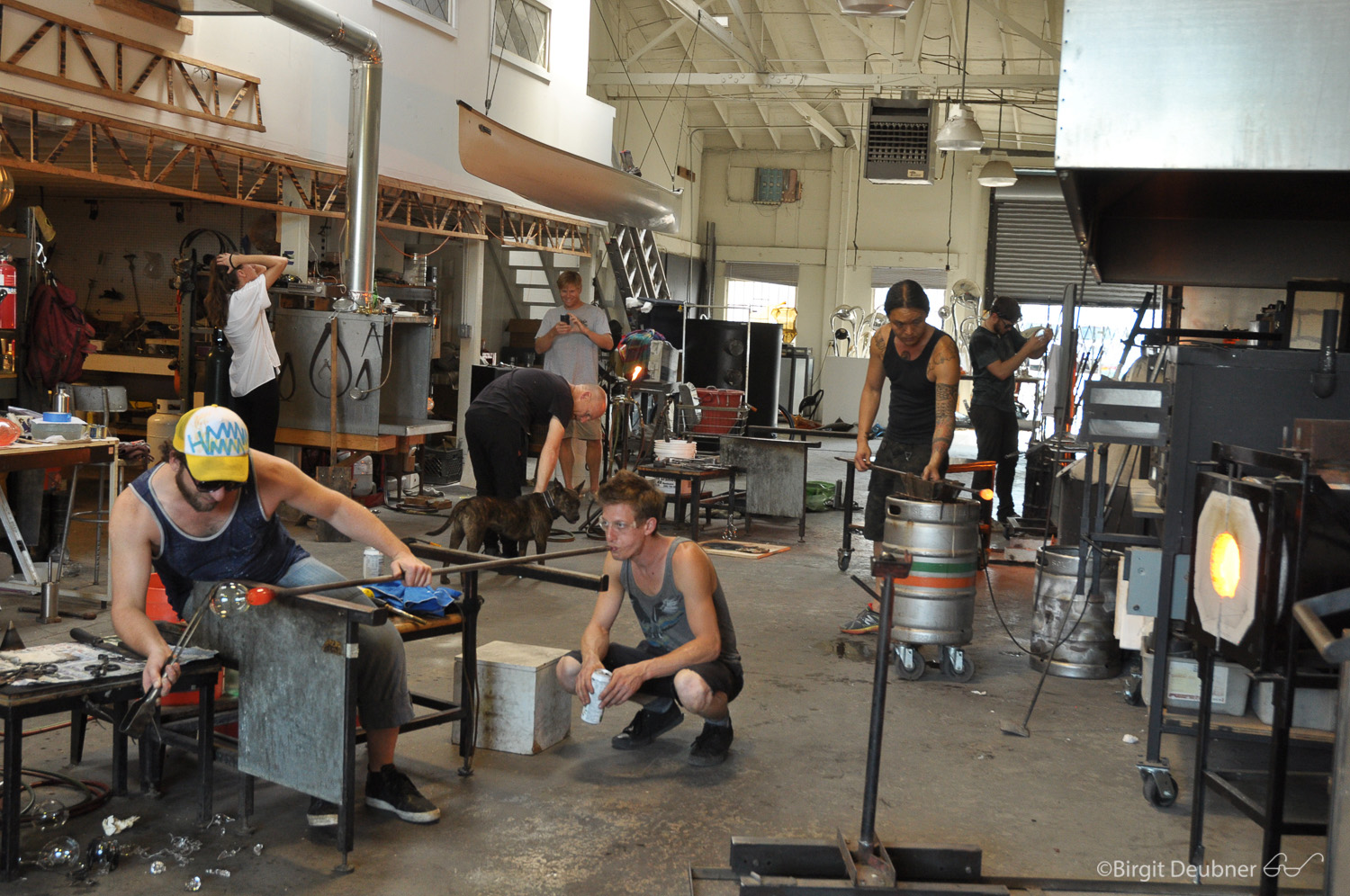
… there was a hive of activity, everybody was working.. David worked on his line of drinking glasses with rocks embedded in them, Evan assisted, Jerry worked with a group of clients with another glassmaker assistant, Heather was just outside the field of vision working on a deadline…
Glow Glas Studio in Oakland, California, full of activity! (David Battaglia, Evan Kolker, Jerry Kung and Cody Nicely assisting + 3 brand new glassblowing students / designers standing around)Jerry Kung explaining somethingDavid Battaglia at work making his rock-drinking glasses
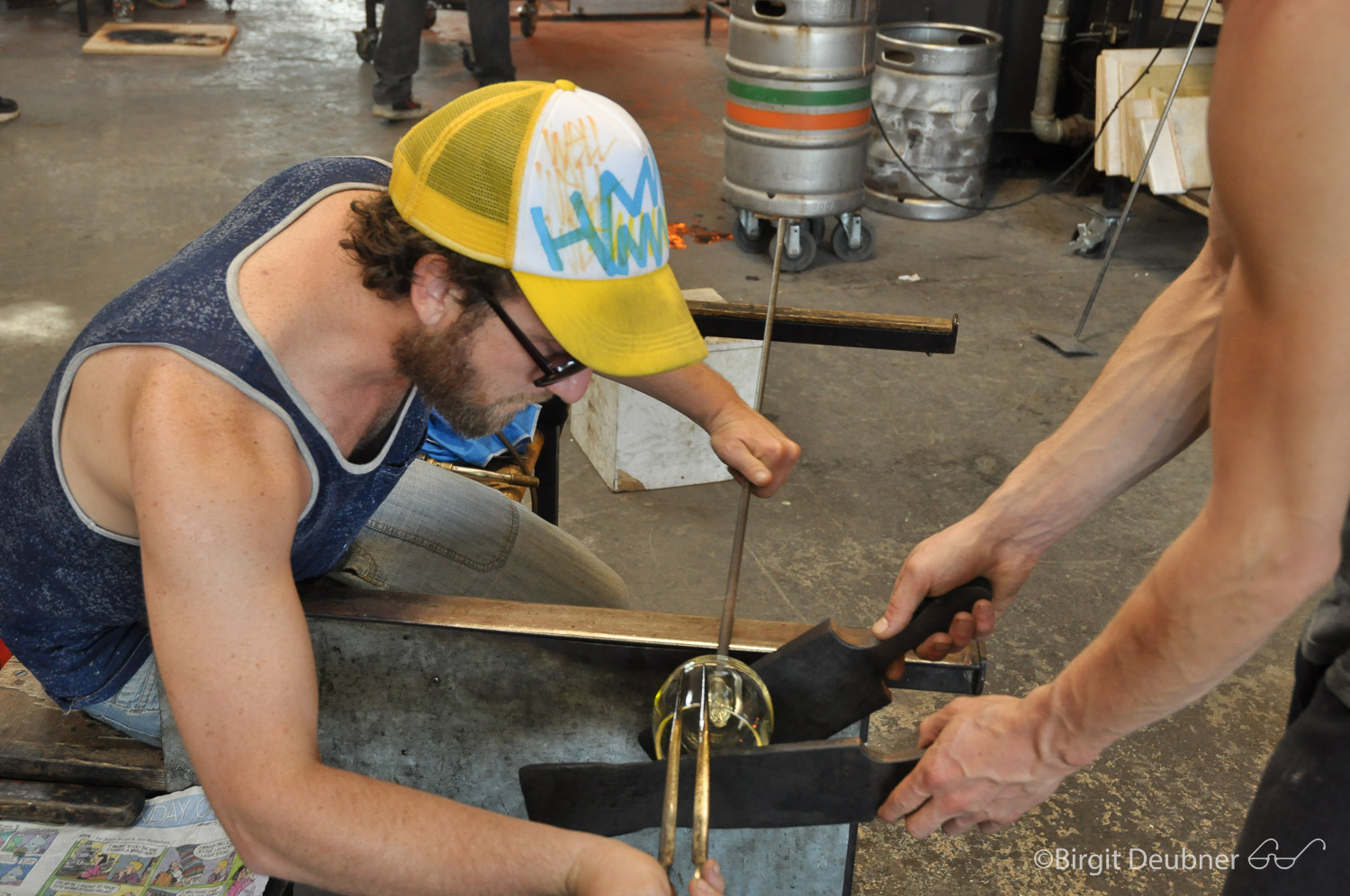
Jerry Kung giving a glassblowing demonstration to his students, with Cody (to the far right) assisting
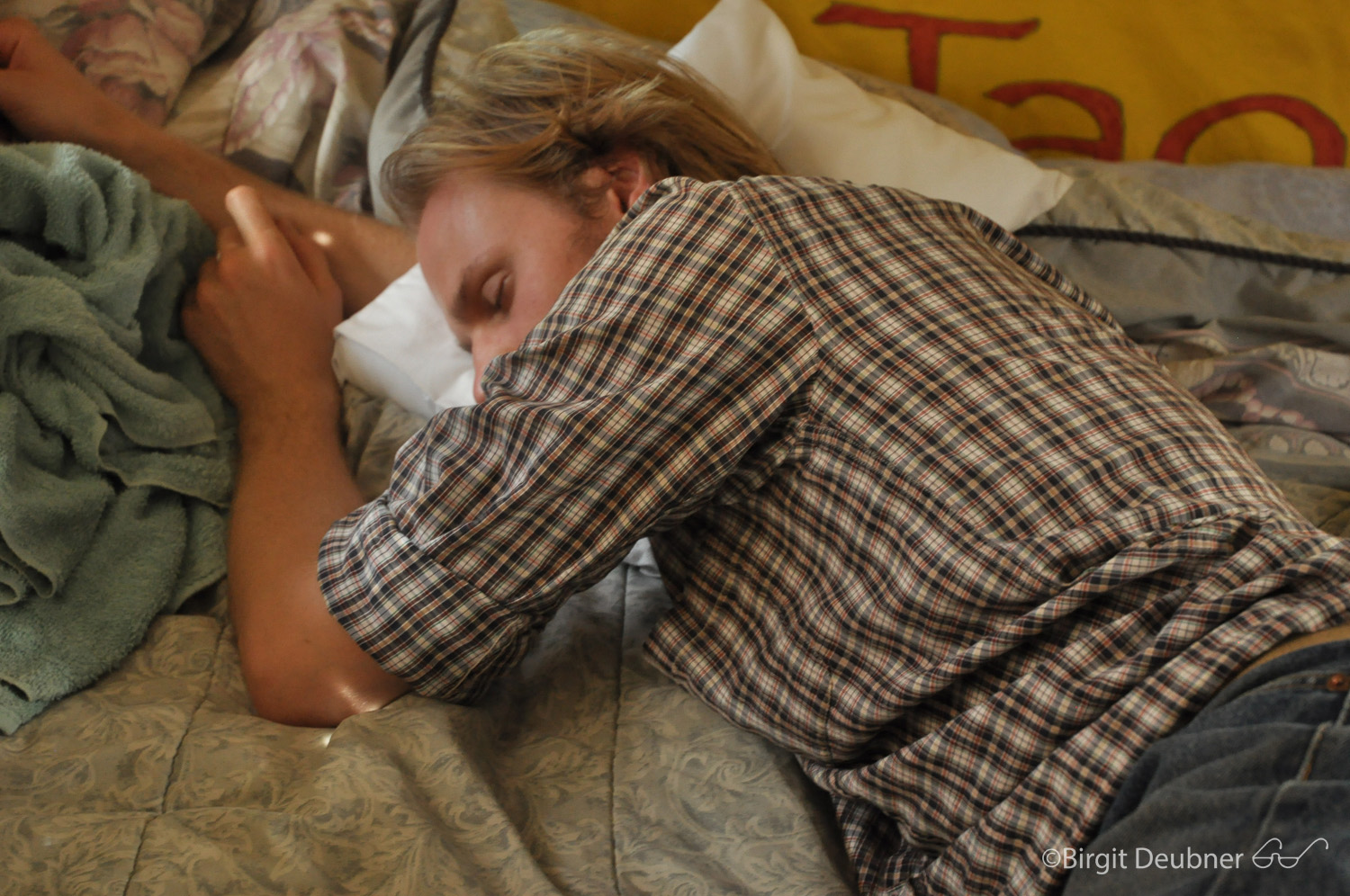
..but where was Jason?
Sometimes every hardworking glassmaker needs a restorative siesta…
This handblown glass bowl takes a total of 26 hours to create. There are 2 separate hot glass blowing processes used, each requiring a 12 hour annealing (precise temperature controlled cooling) and a cold worked engraving process, which takes another craftsman up to an hour for each bowl.
The making of these bowls requires a high level of competent glassmaking craftsmanship, something that Jason has dedicated himself to full time for the past 12 years..
As an outsider I just keep finding it amazing how much physical energy and simultaneous fine tuned technical skill goes into making each object that emerges from the hands of any of the glassmakers here at the studio.
Alex Abajian making custom lampshades matching existing sets precisely. When you work with technically advanced glassmakers you will get what you pay for: very special glass pieces!
Alex Abajian has some serious skills and a few more years of experience than most of the other glassmakers around the studio. It is always additionally exciting when two or more talented makers work together!
… this is where if you were new to glassmaking you would learn about the fact that once in a while each ceramic melting pot, sitting inside the furnace, will develop a crack, due to erosion and unforeseeable factors.. Once the crack deepens it either causes molten glass to leak or an effect takes place that is best described as ‘cords’ developing in the glass, which float on top of the molten glass and can appear in the blown glass pieces as raised cord like areas.. This is rendering the molten glass a lower quality and hence creating an unworkable situation.
This is when it is time to face the challenge and begin a 10 day process of cooling the furnace and molten glass slowly (several days), changing the ceramic crucible (ceramic pot that holds the molten glass) and bringing the furnace and a new batch of glass back up to temperature. The entire process takes somewhere around 10 days.
Of course this can throw a real spanner in the works when multiple glassmakers all booked time to create glassworks, when students lined the doors to take classes… We got lucky and Jason is able to continue teaching his glassblowing classes at Glass Hand Studio, a Glass studio on the lovely island (which originally was a peninsula) Alameda, just down the road from Oakland. Jason had met the owner Prax recently at a Jeff Mack, goblet making workshop that Jason assisted at. We are really happy that Prax can host Jason’s classes!
Jason just received a whole batch of bookings for glassblowing classes through #Verlocal and we are pretty excited about meeting these new students who will be coming for individual short sessions. The first few classes will be at Glass Hand Studio in Alameda before we relocate back to Glow Glass, where Jason usually works with fellow glassmakers, creates his own glass and teaches…
spending the day developing project ideas and making more of the blown glass table set items.. drinking glasses, bowls and functional vessels will be ready soon!
The process benefits tremendously from teamwork. Good communication, a sense of humour a steady hand and years of skill are all requires from both the gaffer (Jason) and his assistant; today Evan Kolker who is an incredible glassmaker, on other days Jason assist him in the making of his intricate and highly technical skill requiring glass art objects! It is a real stroke of luck that Jason found this glassmakers community. Where many colleagues also have very high skills levels. There is also Alex Abajian, the studio owner and another outstanding glassmaker. A series of glassmakers rent the studio and there are a lot of fantastic projects happening here. You wouldn’t know what you are missing until you see what these people make out of molten glass..
Watching the entire process of Jason creating a single seed takes a good 30 – 45 minutes. Many steps are involved in the making of each individual seed. Good timing and control of the glass is essential. ..
Jason Stropko in the process of creating another blown & sculpted glass sunflower seed for his collection of glass nuts & seeds ..Jason Stropko with an almost completed blown & sculpted glass sunflower seed from his collection of glass nuts & seeds .. (Available for purchase anytime.)
Sometimes walking around the glass studio we see some surprises, here is some antique czech glass stemware belonging to Alex Abajian.
The coils that you see the foot being made with: these demonstrate one of the oldest glassmaking process that were used before glass was even blown; whereby molten glass was wound around a clay core to create vessels..
In the foreground: Antique czech glass seen at Alex Abajian’s glass studio in Oakland. (in the background Jason’s tabelware)
This process was followed by the advancements brought by mould making and casting glass and only in 50 BC did blown glass enter the scene.
A beautiful finely made drinking glass with fine white cane work, creating these gorgeous helix patterns embedded within the glass.
This process requires quite some time to prepare each cane of white glass, which then gets cut into shorter strands, heated until soft like stiff honey, stretched and twisted with other clear and white cane to create each individual helix form. These are cooled in the annealer overnight. Cut again into short strands, laid in order, a hot glass cylinder os rolled over the strands of cane, the canes stick to the hot glass, then more heating, more shaping occurs; then finally the shape of a drinking glass emerges after shaping and blowing and shaping and reheating..
This process requires finely tuned skills, patience, focus and a level of endurance, because this is not something you can put down for half an hour when you want to take a break..
(written from the perspective of a glass-layperson)
This was one of the most exciting projects that I have been able to witness at the Glass Studio so far. The teamwork among these glassmakers is really great, there is a huge amount of competency coupled with fantastic working atmosphere. The day is spent working incredibly hard with serious concentration and yet there is always a surprise moment when Alex’s intelligent sense of humour gives occasion for laughter and short refreshing relief. I have rarely seen people work so incredibly well together as here at Glow Glass Studio in Oakland.
Witnessing this process and the attitudes the makers and artists here have with each other has done a lot for my appreciation of the craft and technical skills-manship but also is taking dusting influence over both Jason and my (Birgit’s) future choices of places to live and creative paths to pursue.
Having this opportunity to be here is incredible. Seeing all this hard work affects hugely how I, as an artist and glass-layperson, am able to appreciate this material and the possible forms of expression. Coming from a conceptual arts background it is refreshing to be surrounded by the down to earth labour these creatives are bringing to the table each day.
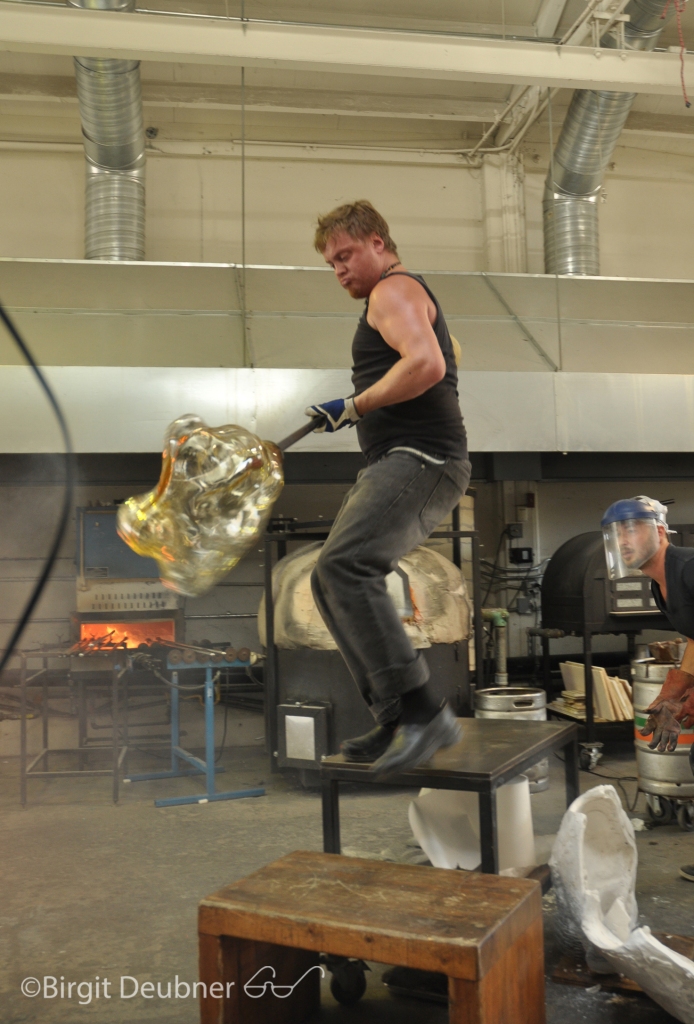
Jason torching the large glass body cast to keep it at even temperature to protect it from cracking before it can be placed into the annealer for a day long, controlled cooling process.. Project by Glass Artist: Ivan Mora
After witnessing just how much dedication and years of skill are required to excel in this field, seeing the amount of dedication as well as equipment required to build a smooth running glassblowing workshop changed my perception a lot. The value of glass in our society is huge, this is an age old but simultaneously incredibly fresh and contemporary medium that can teach us something about the value of an object that a China or Mexico produced (knocked out) mass ware item will never be able to.
When you see or hold handblown glass there is a connection that you will not experience with mass market products. In theory wine, juice or water should taste the same out of every drinking glass for example, however in practice: if you have any sensibility at all then the experience of drinking from a handmade vessel will be far superior and infinitely more pleasurable than from a throwaway valued glass or paper cup..
Alex Abajian holding the blowpipe with the large body cast glass (project for Ivan Mora)Don’t let the price fool you: you will receive what you pay for. A lifelong heirloom treasure or an anonymous object that is the same the world over…
Back to Ivan Mora: look him up! He is a really successful artist making his way in the world; quite literally globally! And all the while he is also a real pleasure to speak with. This is the best combination in an artist isn’t it? Talent, success and absence of attitude. Brilliant stuff!






 Jason Stropko Glass